


THE CANTORIN CODEX : Jorunhild Corvana Ornheim Montclair (Jo)
Recorded in the Cantorin Codex by Ishkar Vale, Master of Indexes, on the recommendation of travelers who survived a border dispute thanks to the Wanderer's intervention.
On the Name and Nature of the Wanderer
Let it be known that Jorunhild Corvana Ornheim Montclair walks the lands between kingdoms, though most sensible folk simply call her Jo.
Her full name translates to "The Battle-loving Friend of Horses and Kings": a title earned not through conquest, but through countless negotiations conducted on horseback between the territories of stubborn rulers. The name suits her, though she'd be the first to tell you it's far too long for a proper introduction when tempers are already running hot.

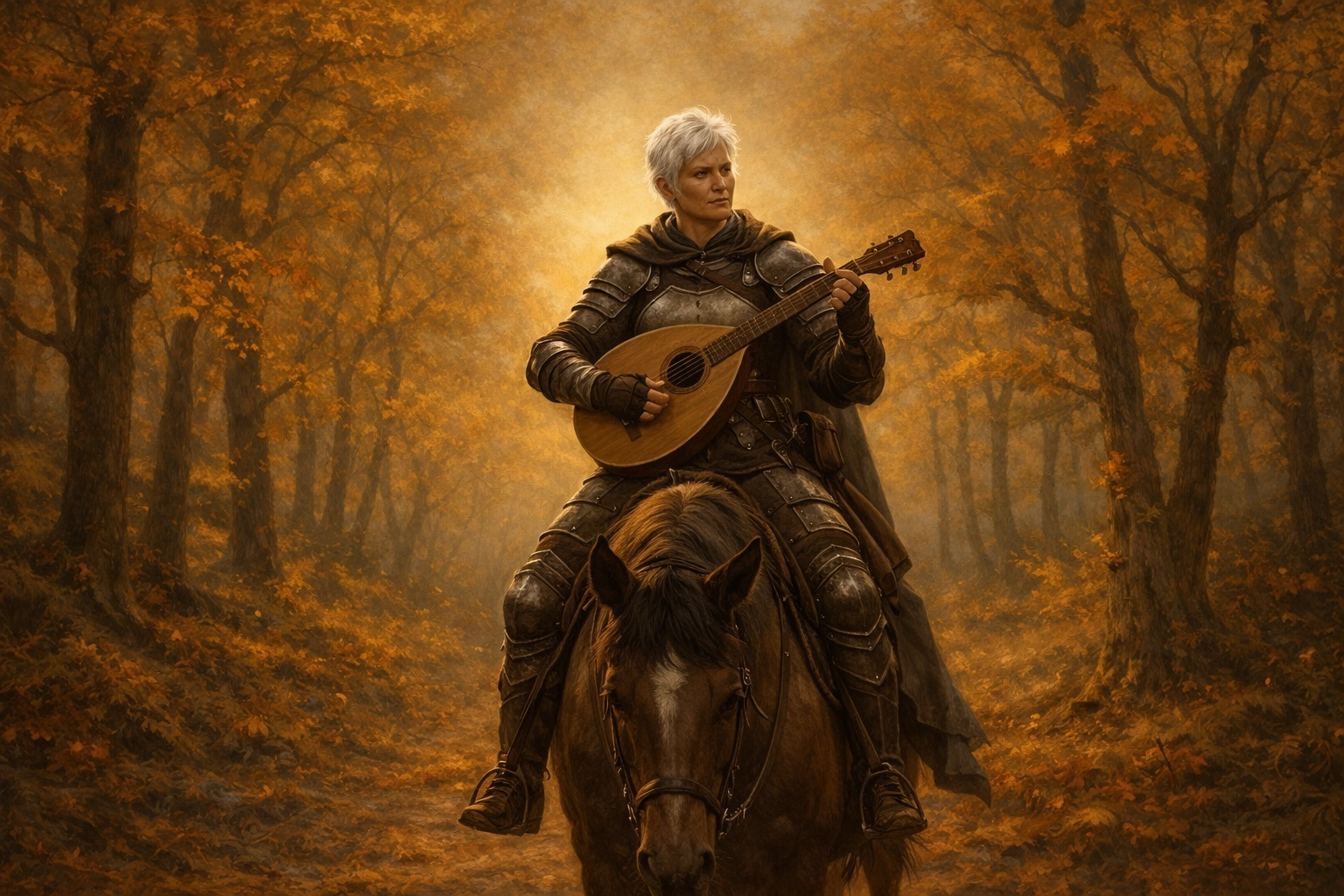
Jo stands tall: taller than most men who've tried to intimidate her: with hair the color of winter clouds, cut short for practicality. At roughly fifty years of age, she carries herself with the easy confidence of someone who's talked their way out of more fights than most warriors have started. She wears no robes of mystical power, no tattered rags of false humility. Instead, she dresses in well-maintained warrior's attire: quality leather reinforced at the joints, boots that have walked a thousand roads, and a green cloak that's seen better days but still serves its purpose.
Two implements never leave her side: a well-balanced sword at her hip and a lute strapped to her back. The sword reminds disputants that she understands violence. The lute reminds them there are better options.
The Profession of Mediation
Jo is what we call a professional mediator: a Wanderer who travels from conflict to conflict, not to join battles but to end them before they begin. In an age where disagreements between villages, merchants, or minor lords can escalate into bloodshed before cooler heads prevail, her services prove invaluable.
Unlike arbitrators who impose solutions by authority, or mercenaries who impose them by force, Jo works through persuasion. She listens to both sides, finds the threads of truth in contradictory stories, and weaves them into agreements that let everyone walk away with dignity intact.
Her methods are simple but effective:
Wit that cuts through posturing and gets to the heart of what people actually want (which is rarely what they claim to want).
Songs that remind hostile parties of their shared history, their common struggles, or simply distract them long enough to stop shouting.
Stories drawn from her decades on the road: cautionary tales of disputes that ended badly, or hopeful ones of old enemies who found unexpected common ground.
She charges fair rates, accepts payment in coin or trade, and has been known to work for nothing more than a warm meal if the cause is just and the parties too poor to pay.
The Misty Lake and Its Dangers
Jo keeps no permanent residence, but travelers most often encounter her near the misty lake: that fog-shrouded body of water where three territories meet and borders blur like the morning mist itself.
The lake serves as natural neutral ground, which makes it ideal for negotiations. It's also dangerous in ways that have nothing to do with human conflict. The mists rise thick and unpredictable, turning day into twilight and hiding sinkholes along the shore. Strange sounds echo across the water: some say it's just birds, others swear the lake itself has moods.
Jo knows the safe paths and the dangerous ones. She knows which clearings offer solid ground for camp and which will flood with the evening tide. She's pulled more than one overconfident merchant out of sucking mud while their rivals watched, which tends to make subsequent negotiations go more smoothly. Nothing builds humility like being rescued from nature's indifference to your commercial disputes.
The ravens that circle the lake have become associated with her presence. Some claim she can speak to them; Jo says they're just scavengers who've learned that humans having loud arguments often means dropped food and unattended packs. Either way, locals take the sight of ravens gathering as a sign that Jo might be nearby.
Methods and Strategies
A successful mediation, according to Jo, follows patterns as reliable as sword forms: though far more flexible in application.
First: The Listening
She meets with each party separately, often over several days. She doesn't interrupt, doesn't argue, doesn't judge. She asks questions that sound simple but aren't: "What would a good outcome look like?" "What are you afraid will happen?" "What would you regret most?"
Most disputes, she's learned, aren't really about the stated issue. The farmer who claims his neighbor's goats destroyed his crops is often more upset that the neighbor never apologized. The merchant who demands payment for allegedly spoiled goods might actually be facing pressure from creditors and need a way to save face.
Second: The Reframing
Once she understands what's actually at stake, Jo brings the parties together on neutral ground: often by the lake, sometimes at The Golden Lantern if the weather turns foul.
She restates each side's position in ways that sound familiar to the speaker but more reasonable to the listener. She highlights common interests they hadn't noticed. She asks them to explain their positions to her as if she were a child who knew nothing of their situation: which often makes them hear how their own arguments sound.
If tensions rise, she reaches for her lute. A well-timed song can break the momentum toward violence better than any stern warning.

Third: The Agreement
Jo doesn't impose solutions. She guides parties toward discovering their own. She asks: "What if you tried this?" "How would that work?" "What would make this fair?"
When an agreement emerges, she writes it down in clear language, has both parties sign, and keeps a copy herself. She's learned that memory turns unreliable the moment people leave the negotiating table.
She also insists on specific terms: not "I'll pay you back when I can" but "I'll pay you three silver marks by the next full moon." Not "We'll stay out of each other's way" but "Your animals stay north of the old oak; mine stay south of it."
Vague agreements breed future disputes. Jo collects future disputes like other people collect debts: she'd rather avoid both.
Tales from the Road
One particular story illustrates her approach well:
Two fishing families had disputed access to a particular cove for three generations. Each had stories of ancestors who "clearly" established their rights. The feud had progressed to vandalized boats and poisoned nets.
Jo listened to both sides for a week. Then she took them both to the disputed cove at dawn and had them fish it: together, from the same boat, alternating who chose the spot and who cast the nets.
By noon they'd caught enough for both families twice over. The cove was most productive with two pairs of hands working it, not one. They'd been fighting so long over who owned the rights to fish it poorly alone that neither had considered fishing it well together.
Jo's solution: alternate weeks, but coordinate timing with tides and seasons. Each family got the cove when it suited their methods best. Both caught more fish. The agreement has held for five years now.
She has a hundred stories like that, though she'd tell you the ones that didn't work are just as instructive. She's been threatened, ignored, and once pushed into a river by a lord who didn't appreciate her suggestion that his "honor" was less important than his farmers' lives. She emerged soaking wet, pulled herself onto the bank, and asked if he felt better now. He did, actually, which let them get back to negotiations.
A Note on Equipment
The sword at Jo's hip is not ceremonial. She's killed men who gave her no choice: bandits mostly, once a hired blade who thought killing a mediator would restart a war his employer could profit from.
She's fast, trained, and absolutely willing to defend herself or others. But she'll try every other option first. The sword is for when talking fails, which happens less often than most people expect.
The lute is equally practical. She knows drinking songs, work songs, lullabies, and ballads. She can perform at The Golden Lantern to earn her keep or play quietly by firelight to ease tension. Music creates space in conversations where argument creates walls.
Both tools serve her profession. Both require maintenance and practice. Both have saved lives.
On Finding the Wanderer
Jo keeps no schedule and answers to no authority but her own conscience. If you need her services, your best approach is to leave word at The Golden Lantern or with merchants traveling the lake road. She checks both regularly.
Be prepared to pay fairly, state your case honestly, and accept that she might refuse if she thinks you're in the wrong or if both sides seem more interested in winning than resolving anything.
If you do secure her help, trust her methods even when they seem strange. She's been doing this for decades. The fact that she's still alive and working suggests her approach works better than most.
And if you see ravens gathering by the misty lake, you might be in luck. Or you might have just dropped your lunch. Either way, Jo's probably closer than you think.
This entry shall be maintained and updated as reports of the Wanderer's ongoing mediations reach the archive. Those with verifiable accounts of Jo Corvana's work are encouraged to submit them to Ishkar Vale for inclusion.
: The Cantorin Codex remains open to all who seek knowledge of the world's notable figures and places.
For inquiries, contact blog@cantorin.com
Comments